
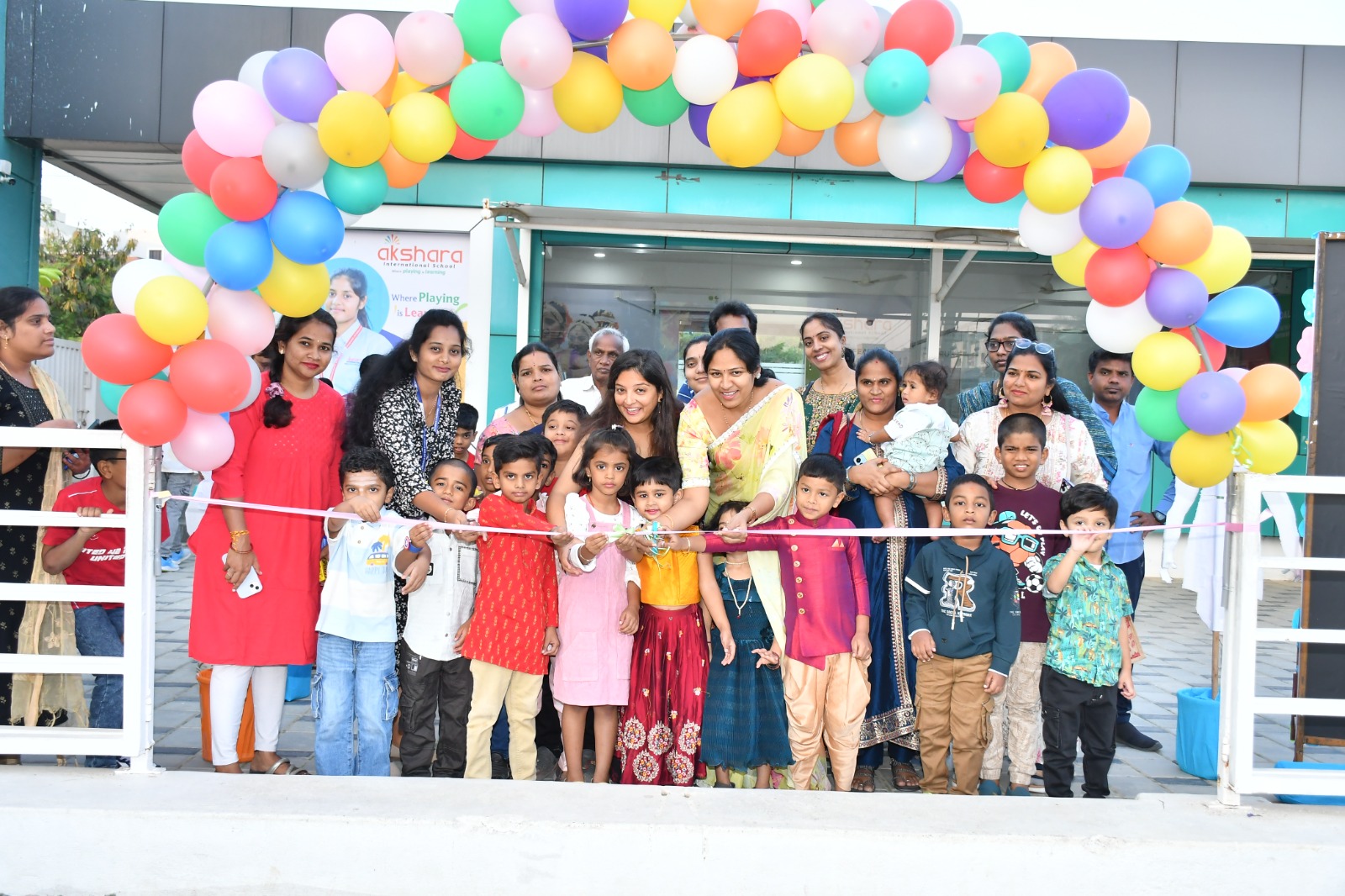
International Yoga Day Celebration at Akshara International School

Date: June 21, 2025
Location: All Akshara International School campuses

Embracing Wellness Through Yoga

Akshara International School proudly celebrated International Yoga Day 2025 across all its branches with great enthusiasm and spirit. The event highlighted our commitment to nurturing physical well-being, mental clarity, and emotional balance among our students.

A Day of Unity, Discipline, and Mindfulness

The morning began with students and staff gathering on campus for a peaceful and energizing yoga session. Under the guidance of experienced yoga instructors, students performed a series of asanas, breathing exercises (pranayama), and meditation techniques.

From Surya Namaskar to Trikonasana, each pose was a step toward developing discipline, focus, and inner peace — qualities that align perfectly with the values we instill at Akshara.

Learning Beyond the Classroom

Our celebration wasn’t just about physical postures — students also learned about the origin of Yoga in India, its global impact, and how it promotes a healthy lifestyle in today’s fast-paced world. Activities like quizzes, poster-making, and speeches made the experience even more engaging and educational.

A School That Cares for Holistic Growth

At Akshara International School, we believe that education is not limited to textbooks. By integrating practices like Yoga into our school culture, we aim to foster holistic development, self-awareness, and emotional resilience in every Aksharite.


  • International Yoga Day 2025
  • Yoga celebration in schools
  • Akshara International School events
  • Yoga for students
  • Mindfulness in education
  • Holistic development in schools
  • Yoga in Indian schools
  • School wellness programs

Modern Wars: Understanding Today’s Conflicts in a Student’s World

🌍 Introduction: Wars Beyond the Battlefield

War today is not just tanks and missiles—it’s misinformation, cyberattacks, mental stress, and social media pressure. At Akshara International School, we believe in helping students make sense of the world they live in—including the conflicts that shape it.

We help students understand that while they may not fight with weapons, they’re in the middle of battles every day—battles of thought, emotion, ethics, and resilience.


🔥 1. Real-World Conflicts: Learning Through Awareness

From the Russia-Ukraine war to the Israel-Gaza conflict, our students are growing up in a world where war is often in the headlines.

At Akshara, we:

  • Teach students about these events in age-appropriate ways
  • Focus on values of peace, diplomacy, and empathy
  • Encourage students to think critically about global news and bias
  • Use classroom discussions to reflect on human impact and the importance of conflict resolution

🌐 2. The Digital Battlefield: Misinformation & Cyberwarfare

Modern war often begins with a keyboard, not a gun. Students today face:

  • Misinformation on social media
  • Cyberbullying and online threats
  • Privacy risks and AI-generated manipulation

That’s why we include digital literacy and cyber safety as part of our education at Akshara:

  • Workshops on identifying fake news
  • Lessons on ethical digital behavior
  • Safe use of AI and understanding tech responsibility

🧠 3. Mental Health: The Inner War No One Talks About

While the world fights physical wars, our students often fight emotional battles—stress, anxiety, and peer pressure.

At Akshara, we’re proactive about student wellness:

  • In-school counseling and support
  • Mindfulness and self-reflection practices
  • Open talks on academic pressure, fear of failure, and comparison
  • Encouraging kindness, not competition

⚔️ 4. Academic Competition: Healthy Battles, Not Burnout

Modern schooling can sometimes feel like a war zone of marks, ranks, and resumes. But at Akshara, we believe in:

  • Celebrating effort over just excellence
  • Encouraging collaboration and team projects
  • Recognizing multiple intelligences—not just academic scores
  • Rewarding creativity, problem-solving, and leadership

Our students learn to compete with themselves, not against each other.


📲 5. Trending Topics Students Should Know (2024–2025)

To prepare our learners for the real world, Akshara incorporates discussions on:

  • 🌐 AI and War: How AI is changing warfare and ethics
  • 🛰️ Drone Technology in modern conflict zones
  • 🎮 Gamification of war and violence in media
  • 📉 Global refugee crises and their impact on children
  • 🧠 Mental health crisis in war-affected zones
  • 💻 Cyberattacks on education systems

Nurturing Hearts and Minds: The Role of Social-Emotional Learning (SEL) at Akshara International School

Nurturing Hearts and Minds: The Role of Social-Emotional Learning (SEL) at Akshara International School

At Akshara International School, we understand that education goes far beyond textbooks and tests. True learning involves the heart just as much as the mind. That’s why we prioritize Social-Emotional Learning (SEL) — an essential part of our commitment to holistic student development.

SEL empowers students to understand and manage emotions, build positive relationships, make responsible decisions, and grow into empathetic, self-aware individuals.

What is Social-Emotional Learning (SEL)?

Social-Emotional Learning is the process through which students develop essential life skills such as:

  • Understanding and managing emotions
  • Setting and achieving positive goals
  • Showing empathy for others
  • Building and maintaining healthy relationships
  • Making responsible and caring decisions

It forms the emotional foundation needed for academic achievement and life success.

Why SEL Matters in Today’s Classrooms

In an age where children face emotional challenges from academics to social pressures, SEL offers practical tools to help students:

  • Manage stress and anxiety
  • Stay focused and motivated
  • Enhance teamwork and communication
  • Develop resilience and self-awareness
  • Become confident and empathetic individuals

Our Approach to SEL at Akshara

We believe that social-emotional learning should be integrated into everyday school life. Here’s how SEL is nurtured at Akshara:

1. Mindfulness and Reflection

Each day begins with mindfulness exercises and gratitude journaling, helping students center their emotions and begin positively.

2. Circle Time & Emotional Expression

We create safe spaces where students share feelings, resolve conflicts, and support each other under teacher guidance.

3. SEL-Integrated Curriculum

CBSE lessons are complemented with modules on empathy, cooperation, and ethical decision-making.

4. Role-Playing & Interactive Activities

Students participate in drama, storytelling, and situation-based learning to build real-world social skills.

5. Professional Counseling Support

On-campus counselors offer individual and group sessions for emotional well-being, helping students face academic or personal pressures.

Creating an Emotionally Safe and Inclusive Campus

We encourage a school environment where every student feels respected and valued. Whether dealing with exam stress, friendships, or failure, our trained educators respond with patience, empathy, and compassion.

Key Benefits of SEL

  • Improved academic performance and motivation
  • Fewer disciplinary issues and classroom conflicts
  • Increased empathy, teamwork, and social awareness
  • Higher self-esteem and emotional intelligence
  • Stronger mental health and stress management

Preparing Students for Life Beyond School

At Akshara, SEL is not just a support system—it’s a launchpad. Students grow into:

  • Emotionally intelligent leaders
  • Effective communicators and collaborators
  • Responsible, empathetic global citizens

Conclusion: Educating the Whole Child

At Akshara International School, we don’t just build scholars—we nurture well-rounded individuals. Through SEL, our students become thoughtful, resilient, and kind human beings, prepared for life’s academic and emotional challenges.

Because at Akshara, strong hearts shape strong minds.

Admissions Open for 2025–26

  • 📍 Visit: www.akshara.edu.in
  • 📞 Contact: 96930 09999 (WhatsApp Available)
  • 🏫 Locations: A. S. Rao Nagar, Kukatpally, Nadergul, Uppal, Kismatpur, Suchitra, Karimnagar

The Learning Revolution: How Personalized AI is Transforming Education at Akshara International School

Welcome to the Future of Learning

At Akshara International School, we believe every student is unique—and so should be their learning journey. As education continues to evolve, Artificial Intelligence (AI) is revolutionizing classrooms by making learning more personalized, inclusive, and engaging than ever before.

Here’s how AI-powered personalized learning is transforming the student experience across our campuses.


🌐 1. The Shift to Personalized Learning

Gone are the days of “one-size-fits-all” classrooms. With AI integration:

  • Lessons adapt in real-time based on student performance and learning pace.
  • Content is tailored to suit individual learning styles—be it visual, auditory, or kinesthetic.
  • Students get on-demand support, not just during class hours.

At Akshara, our students learn when, how, and at the pace that works best for them.


📊 2. Empowering Teachers with Data-Driven Insights

AI doesn’t just benefit students—it supports teachers too:

  • Analyzes patterns in student assignments, behavior, and assessments.
  • Identifies learning gaps early, enabling targeted interventions.
  • Reduces manual tasks, giving teachers more time for mentorship and engagement.

🧠 3. Supporting Diverse and Neurodiverse Learners

Every learner is different, and AI helps us embrace that diversity:

  • Adapts content for multiple learning formats (text, video, simulation).
  • Offers tools for students with learning disabilities or special needs.
  • Encourages neurodiverse students to excel on their own terms.

At Akshara, inclusion isn’t just a policy—it’s our practice.


⏰ 4. Instant Feedback and Self-Paced Growth

AI tools provide real-time feedback, so students can:

  • Learn from mistakes immediately.
  • Manage time better and track their progress.
  • Build independent learning skills and confidence.

This fosters a culture of self-motivation and continuous improvement.


🌍 5. Bridging Gaps with Equity and Inclusion

AI helps democratize access to high-quality education:

  • Reaches students in remote and underserved areas.
  • Offers multilingual support for diverse language backgrounds.
  • Provides equal opportunities for every learner to succeed.

At Akshara, we’re using technology to bridge, not widen, the gap.


🧭 6. Ethical AI and Human-Centered Classrooms

We ensure AI is used ethically and transparently:

  • Students and parents are aware of what data is tracked and why.
  • Teachers remain at the center—AI assists, not replaces.
  • Strict policies prevent data misuse or algorithmic bias.

Our commitment: safe, respectful, and responsible AI usage.


🚀 7. Preparing Students for an AI-Driven World

Learning with AI means learning about AI:

  • Students develop skills like digital literacy, coding, and computational thinking.
  • Builds a mindset of curiosity, adaptability, and innovation.
  • Equips them to become future-ready leaders and problem-solvers.

🔧 8. Challenges and How We Address Them

While the future is bright, challenges remain:

  • Digital divide still limits access in some communities.
  • Teachers need continuous training on AI tools and interpretation.
  • Ensuring students maintain critical thinking in an AI-assisted world.

At Akshara, we’re investing in infrastructure, training, and digital inclusion to overcome these barriers.


📚 9. Real-World Examples and Success Stories

Edtech platforms like Khanmigo, Century Tech, and Squirrel AI have shown:

  • Increased student engagement and retention.
  • Measurable improvement in academic performance through personalization.

We’re working toward implementing similar tools, customized for our CBSE curriculum and Akshara standards.


🤝 10. A Collaborative Future in Education

The future of learning is not AI vs. educators—it’s AI + Educators + Parents.

We believe in:

  • Strong collaboration across the education ecosystem.
  • Policies that protect student privacy and support inclusive design.
  • Ongoing innovation that puts the learner first.

🌟 Conclusion: Learning the Akshara Way

At Akshara International School, we’re not just teaching students what to learn—we’re helping them discover how to learn, why to learn, and how to thrive in an AI-driven future.

Because when every child learns their way, every child shines.

Akshara International School Pre-Primary Graduation Day – A Memorable Celebration!

We are thrilled to share that the Pre-Primary Graduation Day for the 2024-25 Academic Year at Akshara International School, one of the Best CBSE Schools and Best International Schools in Hyderabad, was a resounding success! The event was filled with joy, pride, and heartwarming moments as our little learners took their first big step toward academic excellence.

The day was filled with delightful performances, joyful cheers, and inspiring speeches. Our young graduates, dressed in their caps and gowns, showcased the remarkable progress they’ve made throughout the year, impressing everyone with their newfound confidence, knowledge, and skills. It was a moment of great pride for parents, teachers, and students alike!

We would like to extend our deepest gratitude to the parents for their continued support and trust in Akshara International School. As one of the Best CBSE Schools and Best International Schools, your encouragement and involvement in your child’s learning journey have played a crucial role in their development and success.

This celebration marks not just the completion of a chapter in our students’ early education, but also the beginning of many more milestones in their academic journey. At Akshara International School, we believe every child has the potential to shine, and we look forward to helping our graduates soar in the years ahead!

Thank you to everyone who made this event memorable, and we can’t wait to see what the future holds for our young learners as they continue to grow and thrive at Akshara International School, one of the Top CBSE Schools and Leading International Schools in the region.

Here’s to many more celebrations of success and growth!

Telangana govt makes Telugu a compulsory subject in CBSE, ICSE, IB, and other board-affiliated schools

The Telangana Government has announced the inclusion of Telugu as a compulsory subject in all CBSE, ICSE, IB, and other Board-affiliated schools within the state starting from the upcoming academic year.

According to the official order, “SINGIDI (Standard Telugu)” will be replaced with “VENNELA (Simple Telugu)” with code (089) as per the CBSE subject list (Language Group – L) for Class IX from the academic year 2025-26, and for Class X from the academic year 2026-2027.

The state government passed the Telangana (Compulsory Teaching and Learning of Telugu in Schools) Act in 2018 to mandate the teaching of Telugu in government schools, as well as CBSE, ICSE, IB, and other Board-affiliated schools. However, the implementation faced several hurdles, particularly with non-Telugu-speaking students and the shortage of qualified teachers.

CBSE Class 10 to Have Two Board Exams in 2026? Pros and Cons Explained

The CBSE’s proposal to introduce two Class 10 board exams in 2026 has sparked a debate among educators, students, and parents. While some see it as an opportunity for flexibility and reduced pressure, others are concerned about the added workload for teachers and students. Will this change streamline academics or create new challenges for the education system? Let’s explore the pros and cons of this proposed reform.

Download the the official document :https://www.cbse.gov.in/cbsenew/documents/SCHEME_BOARD_EXAMS_POLICY_25022025.pdf

The Central Board of Secondary Education (CBSE) has proposed a new pattern for Class 10 board exams. Under CBSE’s draft proposal, students will be given the choice of appearing for two exams in a year from the 2026 academic year. The draft proposal may be sent for feedback by March 9.

The proposal is to provide flexibility to the students and reduce examination stress. Here are the key highlights about the CBSE draft proposal on bi-annual board exams:

  • Exam schedule: Board exams of Classes 10 and 12 will commence on the first Tuesday after February 15 annually.
  • Choice of exams and syllabus: The students can take either or both exams, and the highest mark will be considered. The two proposed exams will be conducted on the full current syllabus.
  • Subjects: Except for Science, Maths, Social Science, Hindi, and English, all other subjects are divided into two groups. One group includes regional and foreign languages, while the other consists of the remaining subjects. Core subjects like Science, Maths, and English will be conducted on specific days. Regional languages and foreign languages will be conducted together in a single sitting.
  • Examination centres: The same examination centres will be used for both attempts. No self-centres will be allowed.
  • Teacher and school responsibilities: Schools will be screened before they are assigned as exam centres, and teacher workload will be managed accordingly.
  • Results and marking: The initial exam marks will be available on DigiLocker, but these will not be the passing documents. A combined mark sheet with the second exam marks, internal assessments, and the best of the two will be given after the second exam. Practical assessment will be done only once.
  • Retake and improvement opportunities: Candidates who fail between one and five subjects in the initial exam can take them again in the second sitting. Examination 1 and 2 will be considered as supplementary examinations.

Understanding the Raman Effect: A Groundbreaking Discovery by Dr. C.V. Raman

The Raman Effect is one of the most significant discoveries in the field of physics, and its impact continues to shape various scientific advancements. On National Science Day, we celebrate this extraordinary breakthrough made by Dr. C.V. Raman, an Indian physicist, whose pioneering work earned him the Nobel Prize in Physics in 1930.

What is the Raman Effect?

The Raman Effect is a phenomenon in which light changes its frequency when it passes through a transparent material, such as water or glass. More specifically, when light interacts with molecules in a medium, it can lose or gain energy, resulting in a shift in the wavelength of the scattered light. This change in wavelength provides valuable information about the molecular composition and structure of the material.

In simple terms, the Raman Effect reveals how light interacts with the molecules of a substance, making it an essential tool in the study of molecular vibrations, chemical compositions, and material properties.

The Discovery

In 1928, Dr. C.V. Raman, along with his colleagues, conducted an experiment where they passed monochromatic light (usually from a laser) through a sample of a substance and observed the scattered light. To their surprise, a small fraction of the scattered light had a different frequency than the incident light. This observation led to the discovery that the frequency shift was due to the interaction of light with the molecules of the substance, a phenomenon that would later be known as the Raman Effect.

This discovery revolutionized the way scientists studied materials. By examining the Raman shift in scattered light, researchers could identify chemical compositions, molecular structures, and even detect impurities in substances. The Raman Effect has since become a cornerstone in spectroscopy, a technique used to explore the properties of matter.

Significance and Applications

Dr. Raman’s discovery has had a profound impact on various fields of science and technology, including:

  1. Molecular and Chemical Analysis: The Raman Effect is widely used in spectroscopy to analyze the molecular structure and chemical composition of substances. It is a non-destructive method, making it invaluable for studying delicate materials, biological samples, and pharmaceuticals.
  2. Material Science: Raman spectroscopy helps scientists understand the properties of different materials, including polymers, nanomaterials, and semiconductors. It plays a critical role in research related to material development and innovation.
  3. Biology and Medicine: The Raman Effect is applied in medical diagnostics to study cells, tissues, and biological molecules. Raman spectroscopy aids in detecting diseases and monitoring treatments by providing detailed information about the molecular composition of biological samples.
  4. Environmental Science: The technique is also used to study pollutants in the environment, including detecting toxic gases and contaminants in water or soil.

The Legacy of Dr. C.V. Raman

Dr. C.V. Raman’s discovery opened up new avenues of research and has since influenced several scientific advancements. His work made India proud, and he became the first Asian to win the Nobel Prize in Physics. Today, his contribution is celebrated worldwide, and the Raman Effect remains a crucial part of scientific studies.

The legacy of Dr. Raman is not only a testament to his brilliance but also a reminder of the importance of curiosity, perseverance, and innovation in scientific discovery. His work continues to inspire scientists, students, and researchers to push the boundaries of knowledge and explore new frontiers in science and technology.

Conclusion

The Raman Effect is a brilliant example of how one discovery can transform our understanding of the world. Dr. C.V. Raman’s groundbreaking work has had a lasting influence on a wide array of scientific fields, from chemistry and physics to medicine and environmental science. As we celebrate National Science Day, let us take a moment to honor his legacy and acknowledge the incredible impact of his discovery on science and humanity.

Akshara International School is proud to acknowledge the importance of such revolutionary discoveries in shaping the future of education and science. We aim to continue inspiring the next generation of scientists and innovators to explore, discover, and contribute to the ever-growing world of knowledge.

#NationalScienceDay #CVRaman #RamanEffect #ScienceInspiration #AksharaInternationalSchool

Title: Akshara International School Nadergul’s First Annual Day Celebration with Chief Guest Dr.K. Laxmi IAS

Content: Akshara International School Nadergul celebrated its First Annual Day in grand style, filled with exciting performances and cherished memories. The event was honored by the presence of Chief Guest, K. Laxmi IAS, the Managing Director of Telangana Warehousing Corporation and Director of the State Gallery of Art.

In recognition of her remarkable contributions to public service and the arts, the school presented her with a token of appreciation. Her inspiring journey continues to motivate both students and staff to strive for excellence and pursue their passions.

A heartfelt thank you to all the students, teachers, parents, and guests for making this milestone event a memorable one. Here’s to more growth, achievements, and celebrations at Akshara International School Nadergul!

Title: Akshara International School Uppal’s First Annual Day Celebration with Chief Guest Agasara Nandini

Content: Akshara International School Uppal’s First Annual Day was a spectacular success, showcasing remarkable performances and creating unforgettable memories. The event was honored by the presence of our esteemed Chief Guest, Agasara Nandini, the first Indian athlete to win an Asian Games medal in Heptathlon.

As a tribute to her incredible accomplishments and support, the school presented her with a ₹1 Lakh cheque. Her inspiring achievements continue to motivate and empower our students and staff. The event was a perfect reflection of Akshara’s dedication to nurturing talent and excellence.

A big thank you to all students, teachers, parents, and guests for making this day truly special. We look forward to many more milestones and celebrations at Akshara International School Uppal!